
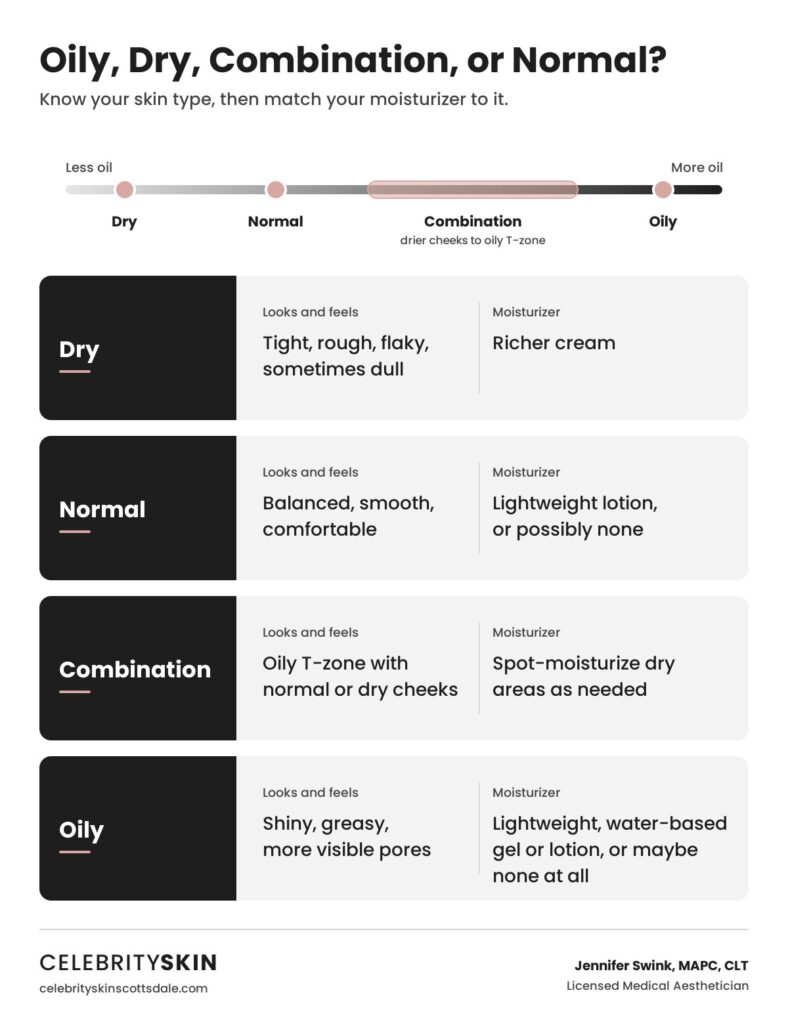
How to identify your skin type starts with observing how much oil your skin produces and where it appears. Oily skin typically looks shiny with more visible pores, dry skin often feels tight or appears rough and flaky, and combination skin has an oily T-zone with normal or dry cheeks. Normal skin generally feels balanced without excessive oiliness or dryness.
Understanding your skin type helps you choose appropriate cleansers, moisturizers, exfoliants, and professional treatments. However, your skin type is only part of the picture. You can have oily skin that’s dehydrated, dry skin that’s acne-prone, or combination skin that’s sensitive.
Table of Contents
What Determines Your Skin Type?
Your skin type is primarily influenced by genetics and hormones, which regulate the activity of your sebaceous (oil-producing) glands. Hormones, particularly androgens such as testosterone, influence how much sebum your skin produces. A scientific review of the hormonal regulation of sebum production explains how androgen signaling and metabolic hormones affect sebaceous gland activity.
Diet and lifestyle can also influence your skin’s oil production, hydration, and overall condition, although their effects vary from person to person.
While genetics establish much of your natural tendency toward oily, dry, or combination skin, how your skin looks and feels can fluctuate throughout your life—and even from one season to another.
Several factors can influence these changes:
- Climate, weather, and seasons: Skin may appear oilier during hot summer months and feel drier during winter. Heat, humidity, and seasonal changes can affect surface oiliness and hydration.
- Humidity and indoor environments: Low humidity, central heating, and air conditioning can contribute to moisture loss, particularly in dry climates like Scottsdale, Arizona.
- Hormones and age: Puberty, menstrual cycles, pregnancy, menopause, and aging can influence oil production, hydration, and skin-barrier function.
- Biological sex: Men generally produce more sebum than women, although there is considerable individual variation.
- Diet and lifestyle: Certain dietary patterns, stress, sleep, and metabolic factors may influence sebaceous gland activity and inflammation.
- Skincare products: Harsh cleansers, excessive exfoliation, and inappropriate moisturizers can disrupt the skin’s moisture balance.
- Medications: Retinoids, hormonal medications, and other treatments can affect oil production or skin hydration.
Research published in Skin Pharmacology and Physiology discusses how skin oiliness varies with age, sex, diet, and environmental conditions.
The key distinction is that your natural skin type and your skin’s current condition aren’t necessarily the same thing. Someone with naturally oily skin can become dehydrated, while someone with dry skin may experience temporary changes in oiliness or sensitivity.
This is why skincare should be adjusted to your skin’s changing needs rather than relying on the same products and routine year-round.
What Does Oily Skin Look Like?
Oily skin produces relatively high amounts of sebum, the natural oil that helps lubricate and protect the skin.
Common characteristics of oily skin include:
- Noticeable shine across much of the face, particularly the forehead, nose, and chin
- Larger or more visible pores
- Makeup that separates or wears off throughout the day
- Skin that feels greasy several hours after cleansing
- A greater tendency toward clogged pores, blackheads, and acne
Although excess oil contributes to acne, it isn’t the only factor. Follicular blockage, inflammation, and Cutibacterium acnes bacteria also play important roles. A scientific review of sebum’s role in acne development explains how these factors interact.
If you’re experiencing persistent breakouts, learn more about the causes and treatment options on our Acne & Breakouts skin-condition page.
Best Skincare for Oily Skin
The goal isn’t to eliminate oil. Sebum plays an important role in maintaining a healthy skin barrier.
Choose a gentle cleanser, lightweight moisturizer when needed, and noncomedogenic sun protection. Ingredients such as salicylic acid can help unclog pores, while niacinamide may help improve the appearance of excess oil.
Avoid harsh cleansers and excessive exfoliation, which can irritate the skin and compromise its protective barrier.
Does oily skin need moisturizer? Not everyone with oily skin needs a rich moisturizer, but oily skin can still become dehydrated. A lightweight gel or lotion may provide sufficient hydration without feeling heavy.
The American Academy of Dermatology’s recommendations for oily skin emphasize gentle cleansing, noncomedogenic products, and appropriate moisturization.
What Does Dry Skin Look Like?
Dry skin generally produces less sebum and may have difficulty maintaining adequate moisture and barrier comfort.
Common characteristics of dry skin include:
- Rough, flaky, or dull-looking skin
- Tightness, especially after cleansing
- Fine lines that appear more noticeable
- Less prominent-looking pores
- Occasional itching, irritation, or sensitivity
Dry skin can become particularly uncomfortable in low-humidity environments. In Scottsdale and throughout Arizona, dry outdoor air and prolonged air conditioning can contribute to moisture loss.
Best Skincare for Dry Skin
Dry skin benefits from gentle cleansing and moisturizers that replenish hydration while supporting the skin barrier.
Look for ingredients such as:
- Ceramides: Help replenish important skin-barrier lipids.
- Glycerin: Attracts and retains water.
- Hyaluronic acid: Helps hydrate the outer layers of the skin.
- Squalane: Helps soften skin and reduce moisture loss.
Cream-based moisturizers are often more appropriate for dry skin than lightweight gels alone.
Dry skin and dehydrated skin are not the same thing. Dry skin is generally associated with insufficient natural oils and protective lipids, while dehydration refers to inadequate water content in the skin’s outer layers.
Both can occur together, but even oily skin can become dehydrated.
For a deeper explanation, read our article Dry vs. Dehydrated Skin: What’s the Difference?, where we explain how climate, hormones, moisturizers, and skin-barrier function influence hydration.
What Does Combination Skin Look Like?
Combination skin has different oil-production patterns across the face.
Most commonly, the forehead, nose, and chin—known as the T-zone—produce more oil, while the cheeks remain normal or dry.
Common characteristics of combination skin include:
- A shiny or oily forehead, nose, and chin
- Normal or dry cheeks
- More visible pores around the nose
- Occasional breakouts in oily areas
- Tightness or flaking in drier areas
Best Skincare for Combination Skin: Spot-Moisturizing
One of the most common mistakes with combination skin is treating the entire face as though every area has the same needs.
You don’t necessarily need to apply the same moisturizer everywhere.
For example, if your cheeks feel dry but your forehead and nose are oily, you can apply a richer moisturizer to your cheeks while using a lighter product—or less moisturizer—on areas that already feel comfortable.
This approach is called spot-moisturizing or targeted moisturizing.
The goal is to give each area what it needs without unnecessarily applying heavy products to oilier areas. If those oily areas feel tight or dehydrated, they may still benefit from lightweight hydration.
The same principle applies to exfoliation. Different areas of the face may tolerate different products or frequencies, particularly when dryness and congestion occur together.
Using products that don’t match your skin’s needs is one reason a skincare routine may fail to deliver the results you expect. Learn more in our article Why Isn’t My Skincare Working? 11 Common Reasons—and How to Fix Them.
What Does Normal Skin Look Like?
Normal skin generally has balanced oil production and good tolerance to everyday skincare.
Common characteristics of normal skin include:
- Relatively smooth, even texture
- Minimal excessive shine or flaking
- Skin that feels comfortable after cleansing
- Less noticeable pores
- Few recurring problems caused by excessive oiliness or dryness
Best Skincare for Normal Skin
Normal skin still requires consistent care. A gentle cleanser, moisturizer as needed, and daily broad-spectrum SPF 30 or higher help maintain skin health.
Normal skin can also develop acne, hyperpigmentation, sensitivity, or signs of aging. Having balanced oil production doesn’t mean your skin is immune to other concerns.
Oily vs. Dry vs. Combination vs. Normal Skin
How to Identify Your Skin Type at Home
The easiest way to identify your skin type at home is with a simple 30–60-minute bare-face test.
- Cleanse your face with a gentle cleanser and lukewarm water.
- Pat your skin dry and leave it bare—no serums, moisturizers, or other skincare products.
- Wait 30–60 minutes, as long as your skin feels comfortable.
- Examine your skin in natural light, paying attention to your forehead, nose, chin, and cheeks.
What do the results mean?
Optional blotting-paper test: Gently press blotting paper against your forehead, nose, and cheeks. Oil on most areas suggests oily skin; oil primarily in the T-zone suggests combination skin.
Important: This is a general observation test, not a definitive diagnosis. Dehydration, harsh cleansers, medications, and environmental conditions can influence your results. If your skin feels tight or irritated, moisturize rather than continuing the test.
Healthy Skin Doesn’t Have to Look Shiny
Forget what TikTok trends and beauty-store marketing may suggest: not everyone needs a glossy, dewy complexion or multiple layers of moisturizer to have healthy skin. That constantly shiny appearance isn’t necessarily a sign of hydration or good skin health.
In our efforts to prevent aging, we sometimes do more than our skin actually needs. Applying overly rich products, layering too many active ingredients, or exfoliating too frequently can contribute to clogged pores, irritation, sensitivity, and a compromised skin barrier.
More skincare doesn’t necessarily mean healthier skin. Your skin needs the right products in the right amounts—not every trending serum, moisturizer, or anti-aging treatment.
The goal isn’t to make every face look shiny. It’s to maintain healthy, balanced skin that functions well and looks its best naturally.
Can Your Skin Type Change With Age?
Yes. Although genetics establish much of your natural tendency toward oily or dry skin, hormonal changes and aging can alter both oil production and the skin’s ability to retain moisture.
During puberty, increased androgen activity commonly stimulates the sebaceous glands, often making skin oilier and more prone to acne.
As we age, hormonal changes can affect sebum production, skin-barrier function, and the skin’s ability to maintain adequate water content. Changes in natural moisturizing factors, epidermal lipids, and barrier function can make it more difficult for skin to retain moisture, contributing to dryness, dehydration, and more noticeable fine lines.
During perimenopause and after menopause, declining estrogen levels may further contribute to reduced hydration, increased dryness, and changes in skin elasticity.
A scientific review of sebum production and hormonal regulation explains how endocrine signaling influences sebaceous gland activity.
Your skincare routine at 50 may therefore need to be very different from the one you used at 20, addressing not only changes in oil production but also the skin’s ability to retain water and maintain a healthy moisture barrier.
Skin Type vs. Skin Condition: Why the Difference Matters
Your skin type refers to your natural tendency toward oily, dry, combination, or normal skin, influenced primarily by genetics and hormones.
Your skin condition describes what your skin is experiencing at a particular time, such as dehydration, acne, sensitivity, or a compromised moisture barrier. These conditions can develop regardless of your underlying skin type and may change over time.
For example:
- Oily skin: Can become dehydrated and feel tight despite producing excess oil.
- Dry skin: May experience additional moisture loss from weather, aging, or skincare products.
- Combination skin: May need different levels of hydration and moisturizing in different areas of the face.
- Normal skin: Can become temporarily dehydrated without necessarily changing its underlying skin type.
This distinction matters because your skin type helps determine which products are appropriate, while your skin’s current condition helps determine what it needs right now.
Someone with oily, dehydrated skin may benefit from a lightweight, water-based moisturizer rather than additional oil-control products. Someone with oily, acne-prone skin may need products that address excess oil and clogged pores without unnecessarily adding heavy moisturizers. Combination skin may benefit from spot-moisturizing only where needed.
How to identify your skin type involves understanding both your skin type and its current condition helps you avoid over-treating or over-moisturizing your skin and develop a more effective skincare routine.
Does Skin Type Affect Professional Treatments?
Yes, but skin type alone shouldn’t determine which professional treatment you receive.
A comprehensive skin evaluation also considers your skin tone, sensitivity, barrier function, acne activity, pigmentation risk, and treatment goals.
For example, someone with oily, congested skin may benefit from customized chemical peels or acne treatments, while someone with dull, dry-looking skin may benefit from gentle exfoliation and hydrating treatments—provided their skin barrier is healthy enough.
Professional exfoliation can also be customized based on whether your skin is oily, dry, combination, or sensitive. As explained in our article Professional vs. At-Home Exfoliation, home skincare and professional treatments serve different purposes and can complement one another.
At Celebrity Skin, treatment recommendations are based on a personalized assessment of your skin, products you are using, medications/condtions, age and overall goals—not simply whether you have oily, dry, or combination skin.
For a more detailed explanation of treatment selection, read How Do I Know Which Skin Treatment Is Right for Me?.
Frequently Asked Questions About Skin Types
How do I identify my skin type?
Identifying your skin type starts with observing how much oil your skin produces and where it appears. Oily skin typically looks shiny with more visible pores, dry skin often feels rough or flaky, and combination skin has an oily T-zone with normal or dry cheeks. Normal skin generally feels balanced without excessive oiliness or dryness.
While genetics and hormones play a primary role in determining your skin type, age, biological sex, weather and climate, skincare products, medications, diet, and lifestyle can all influence your skin’s oil production and overall condition.Can oily skin be dehydrated?
Yes. Oil and water are different components of skin health. Oily skin can produce plenty of sebum while still lacking adequate water in the outer layers.
Should combination skin use moisturizer?
Not necessarily. You can apply richer moisturizers to dry areas while using lightweight hydration on oilier areas as needed. Or, you may use light weight moisturizers on the dry areas and no moisturizer on the oilier areas. It depends on how dry and how oily the areas are along with possibly the climate, menstrual cycle, and possibly more variables affecting skin.
Is sensitive skin a fifth skin type?
Sensitive skin is not a separate skin type because it can affect oily, dry, combination, or normal skin. Sensitivity may be influenced by skincare products, medications, medical conditions, environmental factors, or a compromised skin barrier. It can be temporary or ongoing, depending on the underlying cause.
Can dry skin develop acne?
Yes. Acne is associated with sebum (oil) production, clogged pores, and inflammation. If your skin is acne-prone but feels dry or tight, it may be dehydrated rather than lacking oil. Dehydration means your skin lacks water, not necessarily oil, and can occur even in oily skin.Does skin type change with the seasons?
Your underlying genetic tendencies don’t change with the weather, but heat, humidity, cold temperatures, and indoor heating or air conditioning can influence how oily, dry, or dehydrated your skin becomes.
Does skin type determine which facial is best?
Not by itself. A professional assessment considers skin type, skin conditions, sensitivity, skin tone, and treatment goals before recommending a facial or other procedure.
The Bottom Line
Learning how to identify your skin type helps you choose skincare products that support your skin rather than work against it. But the best skincare routine goes beyond identifying whether your skin is oily, dry, combination, or normal.
Healthy skin requires appropriate cleansing, moisturizing, sun protection, and treatment of any underlying skin conditions.
At Celebrity Skin in Scottsdale, Arizona, we take a personalized approach to skincare and treatment selection, drawing on more than 25 years of experience in clinical aesthetics.
Not sure which products or treatments are appropriate for your skin? Schedule a professional skin consultation at Celebrity Skin to develop a customized skincare routine and treatment plan.